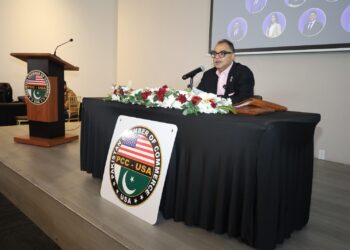
The Quaid i Azam Foundation Houston marked Quaid e Azam Day on December 25 with a community gathering that centered youth voices, bicultural identity, and the continuing relevance of Muhammad Ali Jinnah’s vision for future generations.
The program opened with brief remarks by Dr. Asaf Riyaz Qadeer, Chairman of the Quaid i Azam Foundation Houston, who spoke on the historical significance of December 25 and the principles of unity, faith, discipline, law, and justice that define Quaid e Azam’s enduring legacy.

The youth segment of the program was conducted by Dr. Shabnum Lutafullah, who encouraged students to reflect on their roots and articulate how their education and experiences in the United States shape their sense of responsibility toward Pakistan. She emphasized youth leadership as a vital bridge between cultures and generations.

The youth powerful show began with Areesha Faisal’s impactful speech, who spoke about Quaid e Azam’s vision of law and justice and how it informs her academic goals and career path. “Quaid e Azam’s message of law and justice is not just history for me. It guides my choices, my career, and the kind of professional I want to become,” she said.
Soha, Remy Haynes, and Mairah Saqib followed with reflections on identity, belonging, and the shared values young Pakistanis carry as they navigate life between Pakistan and the United States.
A defining moment of the program came with Aliha Ali’s deeply personal speech on migration and memory. Reflecting on her move from Pakistan to the United States, she captured the emotional cost of displacement, stating, “Migration has a price.” She emphasized that distance does not weaken connection, but deepens responsibility, adding that remembering one’s roots is essential to honoring the sacrifices behind freedom.

Aiza Haris delivered a powerful message on action and accountability, reminding the audience that Pakistan’s future depends on engagement, not nostalgia.
The program concluded with remarks by Aahil Ali, youth leader and Vice President of the Pakistan Youth Forum, who linked education, critical thinking, and service to Quaid e Azam’s long term vision. He left the audience with a strong call to action, stating, “The best gift we can give Baba e Qoum is not applause. It is continuation.”

The program brought together community leaders, families, and young Pakistani Americans whose reflections connected Pakistan’s founding ideals with contemporary life in the United States. The Quaid i Azam Day celebration reflected the Foundation’s commitment to nurturing socially conscious and confident youth who honor Pakistan’s founding principles while actively contributing to their communities in the United States.