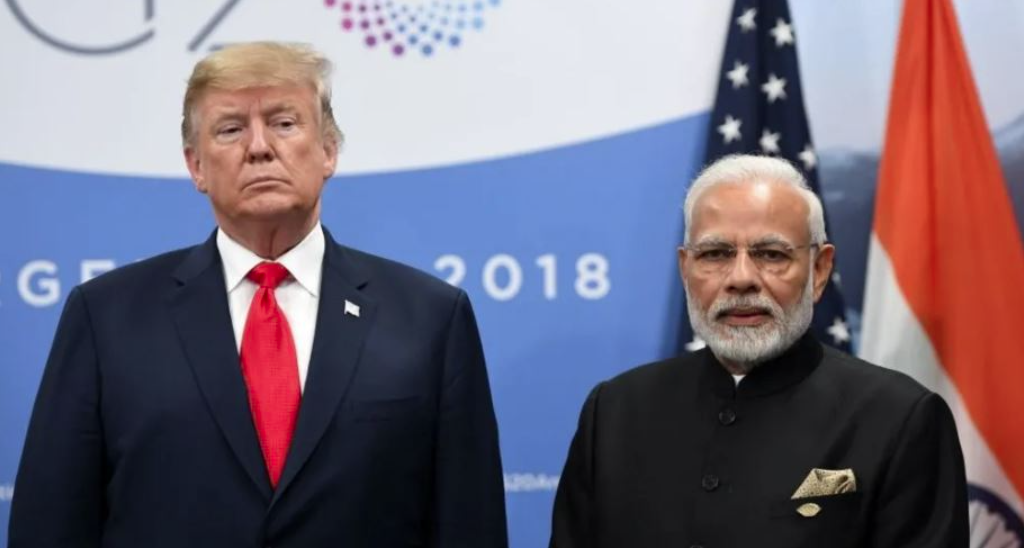
Incoming U.S. President Donald Trump has renewed his criticism of India’s trade policies, threatening to impose reciprocal tariffs in response to what he views as unfair practices. Speaking at a press conference at Mar-a-Lago alongside his commerce secretary pick, Howard Lutnick, Mr. Trump highlighted his longstanding grievances about New Delhi’s high tariff rates.
Trump’s Trade Policy: “America First”
Mr. Trump, known for his “America First” trade policy, had previously revoked India’s preferential trade status in 2019 during his first term. This move led to a contentious tariff war, straining trade relations between the two nations despite the personal camaraderie between Mr. Trump and Indian Prime Minister Narendra Modi.

“Forget about the word tariff for a second,” Mr. Trump remarked. “If they tax us, we tax them the same amount. They tax us. We tax them. And they tax us almost in all cases, and we haven’t been taxing them.”
The former president emphasized the importance of reciprocity, stating: “If India charges us 100 per cent, do we charge them nothing? India charges a lot. Brazil charges a lot. If they want to charge us, that’s fine, but we’re going to charge them the same thing.”
Growing U.S.-India Strategic Ties
While trade tensions with India escalated during Mr. Trump’s first term, broader U.S.-India relations have strengthened over the past two decades. Washington has increasingly viewed India as a strategic partner in countering China’s influence in the Indo-Pacific region. Under President Biden’s administration, these ties have deepened further.
However, analysts warn that a second Trump administration could face renewed trade disputes. Following his recent election victory, Mr. Trump threatened to impose a 100 per cent tariff on BRICS nations—Brazil, Russia, India, China, and South Africa—if they pursue efforts to replace the U.S. dollar in international trade.
Trump’s Warning to BRICS Nations
On 30 November, Mr. Trump declared on Truth Social: “We require a commitment from these countries that they will neither create a new BRICS currency nor back any other currency to replace the mighty U.S. Dollar. Otherwise, they will face 100 per cent tariffs and should expect to say goodbye to selling into the wonderful U.S. economy.”
India’s Confidence in U.S. Relations
Indian Foreign Minister Subrahmanyam Jaishankar expressed confidence in India’s ability to navigate relations with a Trump-led administration. “India is in a much more advantageous position than many other countries to build deeper relations with the incoming Donald Trump 2.0 administration in the U.S.,” he said in December. “Some countries view Trump 2.0 as a political challenge; we do not.”
Past Bonhomie Between Trump and Modi
From 2017 to 2021, the personal relationship between Mr. Trump and Mr. Modi was a highlight of U.S.-India relations. In 2019, Mr. Trump joined Mr. Modi at the “Howdy, Modi!” event in Houston, attended by over 50,000 people. The event showcased their mutual admiration, with Mr. Trump calling Mr. Modi an “exceptional” leader.

The goodwill was reciprocated during Mr. Trump’s 2020 visit to India for the “Namaste Trump” event in Ahmedabad. Mr. Modi described their relationship as a “deep personal friendship,” and the event drew a crowd of 125,000 people at the world’s largest cricket stadium.
Impact of Trump’s Trade Policies on India
In 2019, the Trump administration ended India’s trade privileges under the Generalized System of Preferences (GSP), which had allowed duty-free exports worth up to $5.6 billion. In response, India imposed higher tariffs on 28 U.S. products, including almonds, apples, and walnuts. Despite these trade disputes, the U.S. remains India’s top export destination, with goods and services exports reaching $120 billion in 2023.
Future of U.S.-India Trade Relations
As Mr. Trump prepares to assume office again, the trajectory of U.S.-India trade relations remains uncertain. While strategic ties between the two nations are robust, resolving trade disputes will be critical to ensuring a balanced and mutually beneficial partnership.